
Navigation

Overview

Formulated by dissolving PMMA polymer in safe solvents such as anisole, it functions as a high‑resolution positive e‑beam resist, offering exceptional pattern fidelity, easy processing, and excellent film quality.

Beyond e‑beam lithography, PMMA is also used as a protective coating for wafer thinning, a bonding adhesive, and a sacrificial layer, making it a reliable and flexible material for diverse microfabrication workflows.

Copolymer resists are formulated from PMMA blended with ~8.5% methacrylic acid, making them ideal for bi‑layer lift‑off processes where precise, independent control of CDs and layer profiles is required. Standard formulations use ethyl lactate and are available in a broad range of film thicknesses to support diverse microfabrication workflows. Both PMMA and copolymer resists are offered in package sizes from 500 mL to 20 L, ensuring flexible options for R&D through high‑volume production.

Key features

  • Positive tone
  • E-beam and X-ray imageable
  • Resist developers and strippers
  • Excellent adhesion to most substrates
  • Wide range of film thicknesses

Application Notes

Recommended ancillaries

950 PMMA A

Add to Quote

EBR PG

Edge Bead Remover
Add to Quote

Thinner A

To dilute PMMA A resists
Add to Quote

MIBK IPA 1:1

High speed PMMA & copolymer resist development.
Add to Quote

MIBK IPA 1:2

PMMA & copolymer resist development.
Add to Quote

MIBK IPA 1:3

High resolution PMMA & copolymer resist development.
Add to Quote

MIBK

Add to Quote

Remover PG

To strip PMGI, LOR, PMMA, KMPR® 1000 & minimally cross-linked SU-8 resists
Add to Quote

950 PMMA C

Add to Quote

EBR PG

Edge Bead Remover
Add to Quote

Thinner C

To dilute PMMA C resists
Add to Quote

MIBK IPA 1:1

High speed PMMA & copolymer resist development.
Add to Quote

MIBK IPA 1:2

PMMA & copolymer resist development.
Add to Quote

MIBK IPA 1:3

High resolution PMMA & copolymer resist development.
Add to Quote

MIBK

Add to Quote

Remover PG

To strip PMGI, LOR, PMMA, KMPR® 1000 & minimally cross-linked SU-8 resists
Add to Quote

495 PMMA A

Add to Quote

EBR PG

Edge Bead Remover
Add to Quote

Thinner A

To dilute PMMA A resists
Add to Quote

MIBK IPA 1:1

High speed PMMA & copolymer resist development.
Add to Quote

MIBK IPA 1:2

PMMA & copolymer resist development.
Add to Quote

MIBK IPA 1:3

High resolution PMMA & copolymer resist development.
Add to Quote

MIBK

Add to Quote

Remover PG

To strip PMGI, LOR, PMMA, KMPR® 1000 & minimally cross-linked SU-8 resists
Add to Quote

495 PMMA C

Add to Quote

EBR PG

Edge Bead Remover
Add to Quote

Thinner C

To dilute PMMA C resists
Add to Quote

MIBK IPA 1:1

High speed PMMA & copolymer resist development.
Add to Quote

MIBK IPA 1:2

PMMA & copolymer resist development.
Add to Quote

MIBK IPA 1:3

High resolution PMMA & copolymer resist development.
Add to Quote

MIBK

Add to Quote

Remover PG

To strip PMGI, LOR, PMMA, KMPR® 1000 & minimally cross-linked SU-8 resists
Add to Quote

Process parameters

Coat

Kayaku Advanced Materials PMMA resists produce low defect coatings over a broad range of film thicknesses. The film thickness vs. spin-speed curves displayed in Fig. 2 through 11 provide the information required to select the appropriate PMMA dilution and spin speed needed to achieve the desired film thickness

Recommended Coating Conditions

1. Dispense: STATIC 5–8 ml for a 150 mm wafer
2. Spread: DYNAMIC 500 rpm for 5 seconds, or STATIC 0 rpm for 10 seconds
3. Spin: Ramp to final spin speed at a high acceleration rate and hold for a total of 45 seconds

Prebake

PMMA
Hot plate: 180ºC for 60-90 seconds, or Convection Oven: 170ºC for 30 minutes

Copolymer
Hot plate: 150ºC for 60-90 seconds, or Convection Oven: 140ºC for 30 minutes

*Vacuum oven bake can also be used

Exposure

PMMA can be exposed with various parts of the electromagnetic spectrum.

E-beam Dose: 50–500 μC/cm2 depending on radiation source/equipment & developer used.

Energy: 20–50 kV; higher kV for higher resolution, e.g. 50 kV for 0.1mm images.

X-ray: Sensitivity of PMMA is low, ~1-2 J/cm2 at 8.3 Å. The sensitivity increases at longer x-ray wavelengths. Features of <0.02 μm can be fabricated.

Development

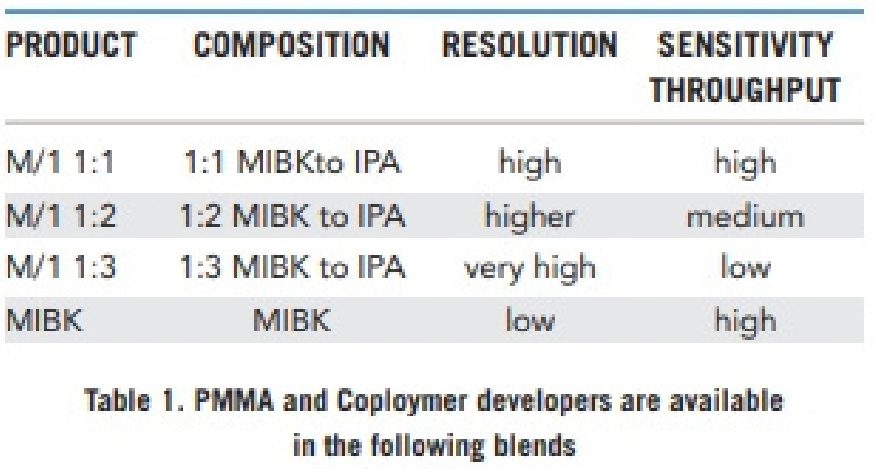
PMMA and copolymer resists are compatible with immersion (21ºC), spray puddle, and spray process modes. Process variables such as soft bake, exposure conditions, choice of resist and developer should be optimized to achieve desired results. For more process details see the PMMA and Copolymer Developer data sheet. Table 1 lists commonly used developers and their recommended usage.

pmma positive resists

Downloads