
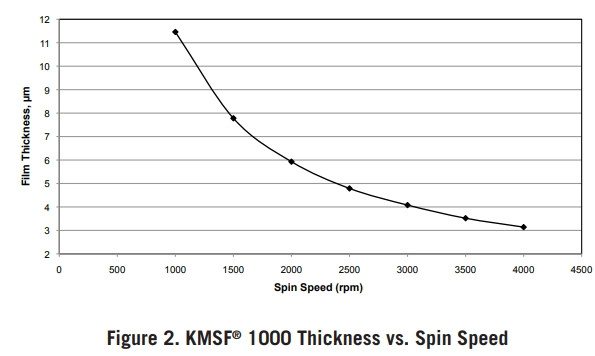
KMSF® 1000 resist is offered in a standard viscosity of 260 cSt. The relationship between film thickness and spin speed is illustrated in Figure 2, based on tests conducted with a Brewer Science® Cee® 200 coater. The tests used a static dispense method on 6″ (150 mm) silicon wafers, followed by a soft bake at 110°C on a leveled hot plate.
*Please note the exact thickness obtained may be slightly offset from Figure 2. due to equipment type, setting differences and room conditions,
A 110°C soft bake for 3 to 10 minutes on a level hotplate with good thermal control and uniformity is recommended. KMSF® 1000 film remains slightly tacky after soft bake thus hard contact exposure should be avoided.
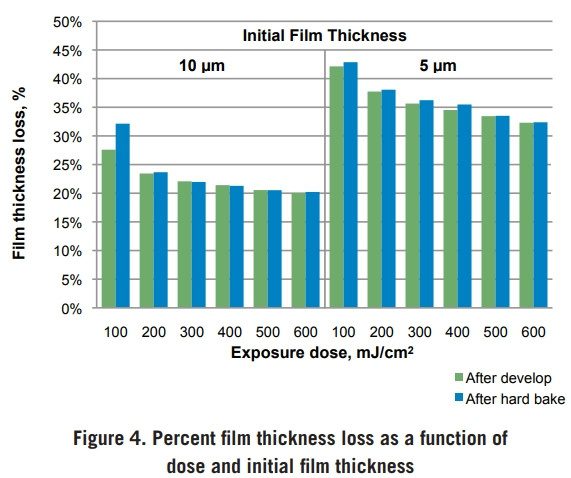
KMSF® 1000 is compatible with i-Line and broadband exposure tools. The film typically remains tacky after soft bake therefore, hard contact alignment should be avoided. Bulk film thickness loss associated with exposure and development is typically observed. The film loss is a function of the exposure dose as depicted in Figure 4. Higher doses result in lower film loss and higher final film thickness. For minimum film loss, a broadband exposure dose greater than 400 mJ/cm2 (high pressure Hg vapor lamp) measured at 365 nm is recommended.