

Navigation

Overview

KMSF® 1000 is a negative‑tone, polyimide‑based photo‑dielectric designed for ultra‑low‑stress buffering, passivation, and protective layers in advanced microelectronic packaging. Engineered to provide exceptional warpage control, it is well suited for thin and large‑diameter substrates commonly used in backend assembly processes. With low shrinkage, a very low tensile modulus, and minimal thermal cure requirements, KMSF® 1000 delivers reliable performance across demanding packaging applications. Consistent single-coat film thicknesses of approximately
3–10 µm can be achieved, enabling uniform dielectric layers with reduced mechanical stress.

Key features

  • i-Line/broadband sensitivity
  • 1:1 aspect ratio imaging
  • Solvent development
  • Low temperature cure < 200°C
  • Excellent thermal & chemical stability
  • No warpage due to low shrinkage and tensile modulus.
  • High electrical reliability enabled by
  • Very low moisture absorption
  • No Post Exposure Bake required

Industry Applications

  • Advanced semiconductor packaging

  • Wafer-level packaging

  • MEMS & microsystems

  • Heterogeneous integration platforms

Documentation

Tech Reference #1

Micro-transfer printing of GaN HEMTs on engineered substrates for use in harsh environments
Meilander, O. R. et al., APL Electronic Devices, 2025

Download Publication

Recommended ancillaries

EBR PG

Edge Bead Remover
Add to Quote

KMSF® Developer

Development of KMSF 1000
Add to Quote

Remover PG

To strip PMGI, LOR, PMMA, KMPR® 1000 & minimally cross-linked SU-8 resists
Add to Quote

Process parameters

Coat

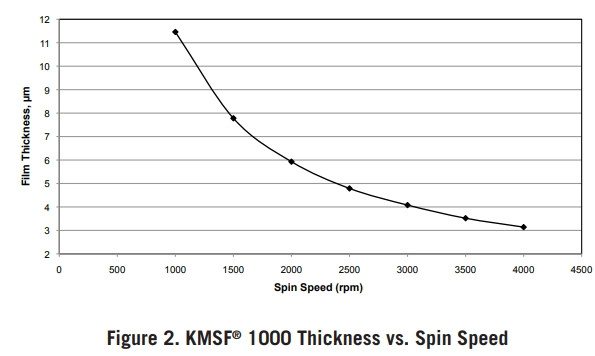
KMSF® 1000 resist is offered in a standard viscosity of 260 cSt. The relationship between film thickness and spin speed is illustrated in Figure 2, based on tests conducted with a Brewer Science® Cee® 200 coater. The tests used a static dispense method on 6″ (150 mm) silicon wafers, followed by a soft bake at 110°C on a leveled hot plate.

*Please note the exact thickness obtained may be slightly offset from Figure 2. due to equipment type, setting differences and room conditions,
Recommended Program

  1. Dispense 1 ml of resist for each inch (25 mm) of substrate diameter
  2. Spin at 500 rpm for 5–10 seconds with acceleration of 500 rpm/second
  3. Spin at 1000-4000 rpm for 30 seconds with acceleration of 500 rpm/second

kmsf 1000 thickness vs spin speed table

Soft Bake

A 110°C soft bake for 3 to 10 minutes on a level hotplate with good thermal control and uniformity is recommended. KMSF® 1000 film remains slightly tacky after soft bake thus hard contact exposure should be avoided.

Exposure

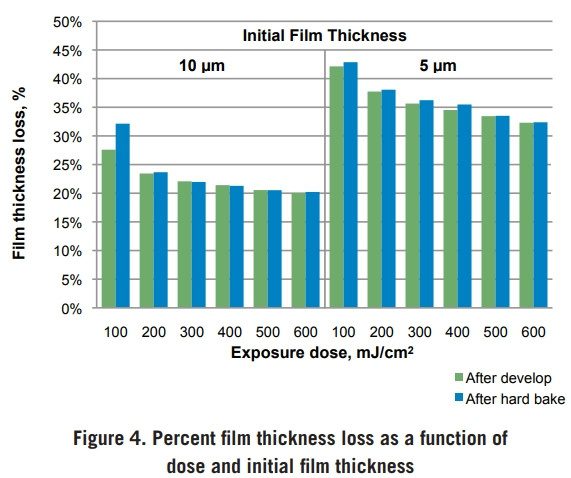
KMSF® 1000 is compatible with i-Line and broadband exposure tools. The film typically remains tacky after soft bake therefore, hard contact alignment should be avoided. Bulk film thickness loss associated with exposure and development is typically observed. The film loss is a function of the exposure dose as depicted in Figure 4. Higher doses result in lower film loss and higher final film thickness. For minimum film loss, a broadband exposure dose greater than 400 mJ/cm2 (high pressure Hg vapor lamp) measured at 365 nm is recommended.
Development

KMSF® 1000 resist is optimized for development in solvent-based KMSF® Developer using immersion, spray, puddle or spray/puddle methods. A typical spray puddle process at 23˚C would be 70 rpm, 60 seconds spray, 60 seconds puddle followed by a 60 seconds spray