Overview
UniLOR® N is a negative-tone, chemically amplified proprietary co-polymer lift-off photoresist series for UV photolithography in semiconductors, MEMS, and other nanofabricated structures. The UniLOR® N 5.0 formulation is optimized for large undercut lift-off processes, providing adjustable wall profiles and high thermal stability across a broad range of film thicknesses. This large undercut lift-off process enables reliable pattern transfer during non-directional metal and oxide deposition while maintaining straightforward removal using NMP- or DMSO-based removers. Please refer to the UniLOR® N Datasheet for additional information on the product series and standard processing guidelines for directional deposition methods.
Key Features
- Adjustable profile
- High temperature profile stability
- Excellent adhesion to various substrates (Si, GaAs, SiC)
- Compatible with standard TMAH Developers
- Easy removal with NMP or DMSO based removers
Application
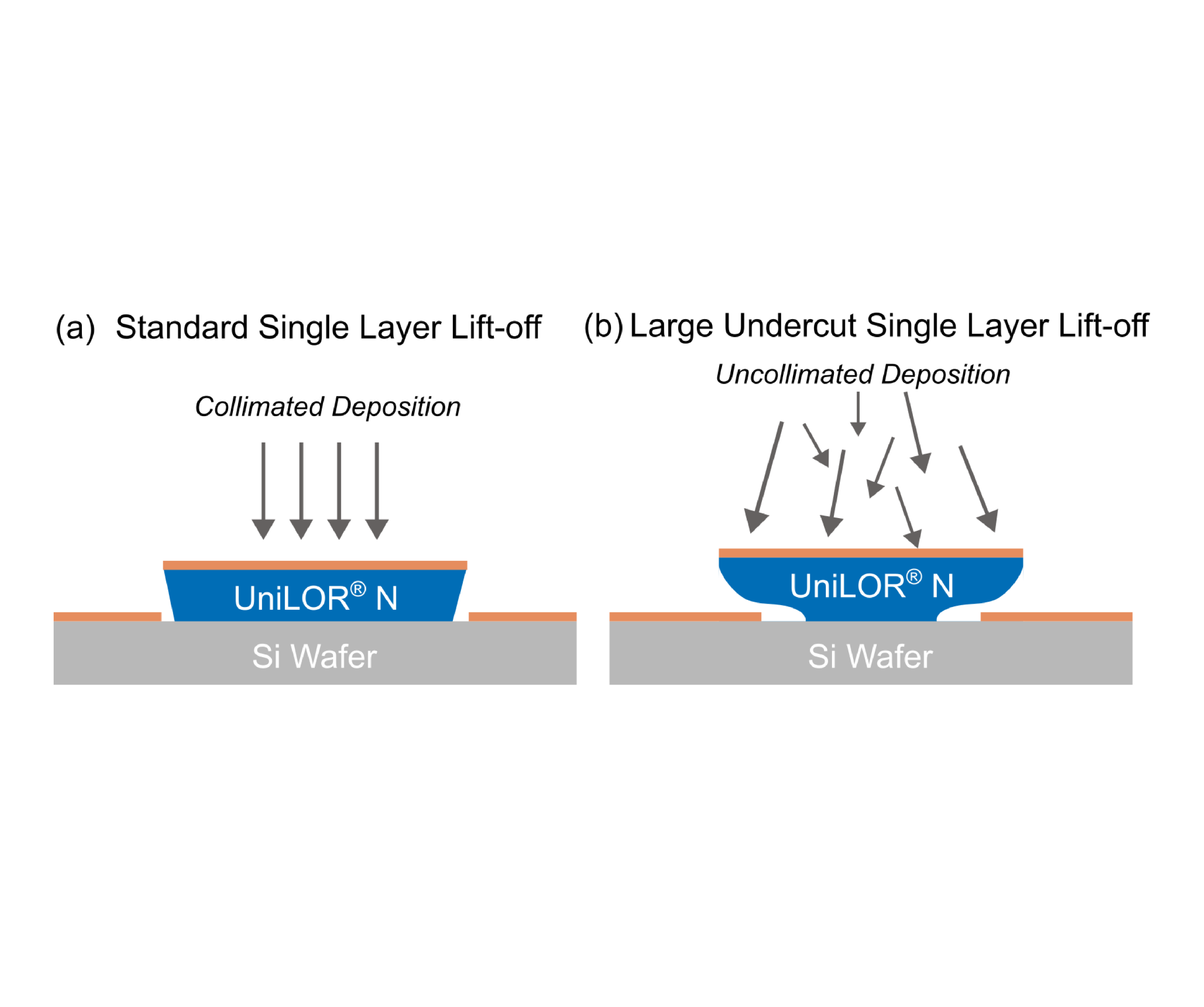
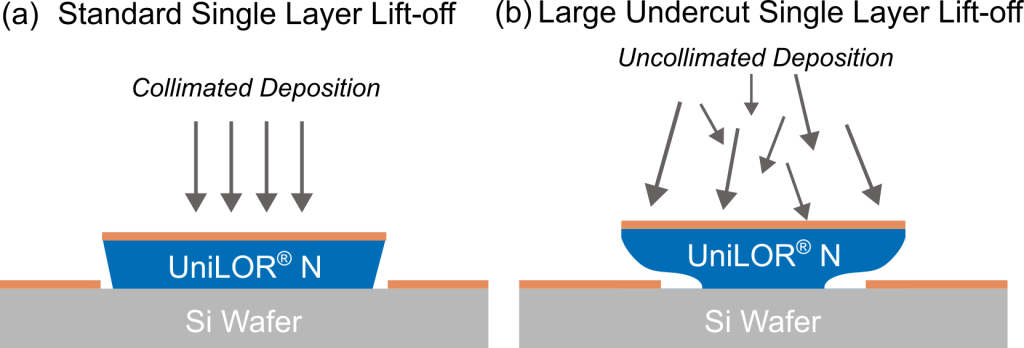
Single layer lift-off is a process used for patterning metal and oxide layers in semiconductor or other nanofabricated devices. To accomplish this, lift-off resists must have an inward sloping or undercutting wall profile (Figure 1). Without this type of profile, the deposited material will completely encapsulate the resist which can prevent clean removal or introduce defects into the deposited material. For directional methods, a slightly tapered wall profile will prevent the resist from becoming encapsulated (Figure 1a). However, when using uncollimated methods, a large undercut profile is desired to ensure successful lift-off (Figure 1b). Due to the thickness of the UniLOR® N 5.0 dilution, the resist can be fabricated with a large undercut by adjusting the process conditions as described here. For lift-off of very thick, multi-layered, or materials that require high temperature deposition, see the UniLOR® N Thermal Stability Application Note from Kayaku Advanced Materials for information on bi-layer processing.
Processing Conditions
UniLOR® N 5.0 is highly sensitive to process changes, especially with regards to the undercut profile for thicknesses > 5 μm. The soft bake step offers the most control over the undercut rate. Higher soft bake temperatures will decrease the undercut rate during the development step, allowing more precise control over the final undercut width, while increasing the time needed to develop. Development time is the main control lever for undercut width.
Importantly, the exposure dose and post exposure bake (PEB) offer increased control over the undercut height and width. Increasing the dose and PEB time/temperature will decrease the undercut height and width as the resist effectively crosslinks from the top down. Here, a lower than standard dose is used to expose the top of the resist while partially exposing the bottom. This creates the undercut profile seen in Figure 2. See Table 1 for large undercut process conditions.
| Processing Conditions | |
|---|---|
| Coat | Dispense 1 mL/inch of HMDS-primed Si substrate 1000-2000 rpm for 30 sec |
| Soft Bake | 3 min @ 115°C |
| Exposure (at 365 nm) | 200 mJ/cm² Verify dose for your specific tool and filter set-up. |
| Post Exposure Bake | 3 min @120°C |
| Development | TMAH-based developer Time depends on desired undercut |
| Deposition | Deposit desired material for patterning |
| Removal | 30 min in NMP or DMSO-based remover. Heat to 50°C and/or sonicate for faster removal |
Table 1. Typical processing conditions used for large undercut single layer processing of UniLOR® N 5.0

Kayaku Advanced Materials recommends an undercut width to height ratio of 2:1 to avoid sealing off the resist during deposition. Completely sealed resist will impair or prevent removal and can introduce defects in the deposited layer. Please contact Kayaku Advanced Materials if you have questions about lift-off for your specific application.