Overview
SU-8 3000CF Dry Film Resist (DFR) is a low-halogen, antimony-free epoxy photoresist designed for fabricating high aspect ratio microstructures in microfluidic, MEMS, and advanced microelectronic applications. Available in 20, 30, and 45 μm film thicknesses, the dry film format provides highly uniform layers with precise and repeatable thickness control. A key advantage of SU-8 3000CF DFR is its ability to be laminated and stacked sequentially, enabling thicker structures to be fabricated while maintaining excellent resolution, vertical sidewalls, and mechanical stability. The material can be processed using both industrial automatic laminators and desktop laboratory laminators, making it suitable for research, prototyping, and high-volume manufacturing. This application note demonstrates two approaches for fabricating microfluidic devices: sequential stacking of SU-8 3000CF DFR layers and a hybrid process combining spin-coated liquid SU-8 with laminated SU-8 3000CF DFR. These approaches provide flexible solutions for achieving precise channel heights and complex microfluidic architectures.
Application
Microfluidic devices require channels with precise heights, vertical sidewalls, and smooth surfaces to ensure predictable fluid flow and reliable device performance. SU-8 3000CF DFR is well suited for fabricating microfluidic channels, master molds, cavity structures, and capping layers, providing excellent dimensional control and high feature fidelity. The availability of multiple dry film thicknesses enables precise control of channel height through sequential lamination, while hybrid processing with liquid SU-8 expands the achievable design space for more complex device architectures. Together, these fabrication approaches support both rapid prototyping and scalable manufacturing while maintaining high-resolution and high aspect ratio microstructures.
Key Features
- High Resolution and Aspect Ratio >3:1
- Uniform film thickness through dry film lamination
- Strong adhesion to common substrates (Si, glass)
- Multi-layer processing capability for complex channel architectures
- Low Water Absorption
- Proven Reliability with No Delamination or Corrosion after HAST (85 ºC, 85% RH, 168 hrs)
Processing Information
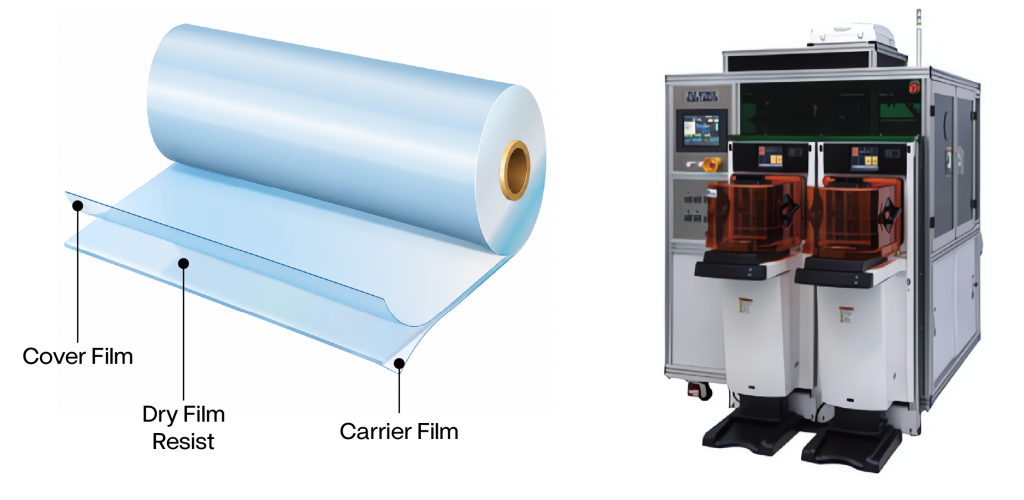
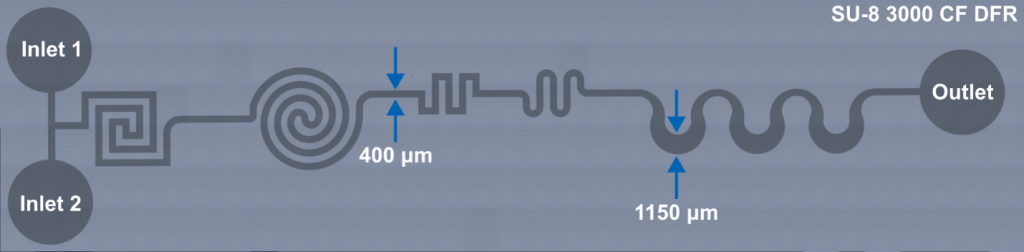
For demonstration of SU-8 3000CF for microfluidics applications, a microfluidic cell design was printed with a 2-layer stack of SU-8 3045CF DFR using a TTS Automatic Laminator. The TTS Automatic laminator (Figure 1) is an industrial-level tool for efficient processing of wafers using DFR. Some process optimization is expected depending on the type of laminator in use. If your team is interested in support for lamination services, please reach out to [email protected].
Dry Film Only
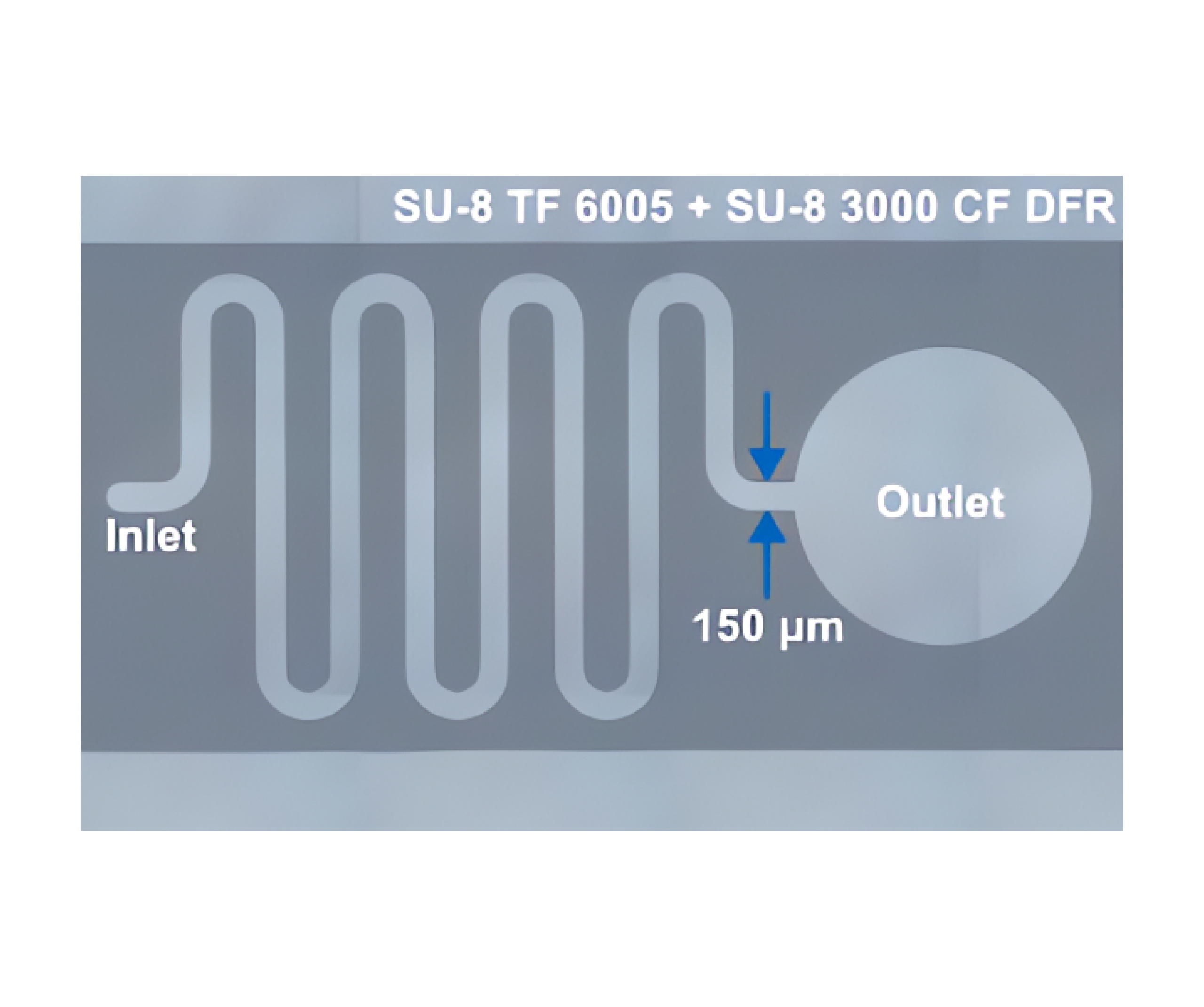
Film processing information for the 2-layer dry film microfluidic device is included below in Table 1, followed by lamination conditions in Table 2. The final device shows inlet and outlet features along with defined fluid flow paths for the microfluidic cell. The channels are 90 μm deep from the 2-layer processing of SU-8 TF 6005 and 3045CF DFR (Figure 2).
| Process Step | |
|---|---|
| Lamination | TTS Automatic Laminator DXL2 |
| Post Lamination Bake Recommended for best adhesion | 30 min @ 95°C per stack |
| Exposure 365 nm wavelength | 350mJ/cm² Verify intensity for your specific tool and filter set-up |
| PEB | 5 min @ 65°C + 5 min @ 95°C |
| Development | Dirty/Clean 2 bath method with SU-8 Developer: 5 min in each bath To clean any remaining residue, use spray puddle method: 3 x 1min |
| Hard Bake | 30 min @ 150°C on hotplate |
TTS Lamination Recipe
Recipe may vary based on laminator.
| Layer 1 | Stage Temp/ Roller Temp | 60°C/60°C |
| Speed | 5mm/sec | |
| Pressure | 350kPa | |
| Layer 2 | Stage Temp/ Roller Temp | 60°C/60°C |
| Speed | 10mm/sec | |
| Pressure | 250kPa |
Liquid + Dry Film
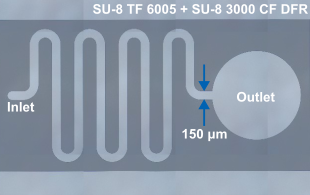
Film processing information for the combined liquid and dry film microfluidic device is included below in Table 3, followed by lamination conditions in Table 4. The final device shows inlet and outlet features along with defined fluid flow paths for the microfluidic cell. The channels are 50 μm deep from the 2-layer processing of SU-8 TF 6005 and 3045CF DFR (Figure 3).
| Liquid Coating | SU-8 TF 6005 @ 5 µm film thickness |
| Liquid Soft Bake | 5 min @ 110°C |
| Lamination | TTS Automatic Laminator DXL2 |
| Post Lamination Bake Recommended for best adhesion | 30 min @ 95°C per stack |
| Exposure 365 nm wavelength | 350mJ/cm² Verify intensity for your specific tool and filter set-up |
| PEB | 5 min @ 65°C + 10 min @ 95°C |
| Development | Dirty/Clean 2 bath method with SU-8 Developer: 10 min in each bath To clean any remaining residue, use spray puddle method: |
| Hard Bake | 30 min @ 150°C on hotplate |
| Stage Temp/ Roller Temp | 60°C/60°C |
| Speed | 5mm/sec |
| Pressure | 350kPa |
Industrial Relevance
Dry film resists are widely adopted for applications requiring tight thickness control, process consistency and repeatability.[1] SU-8 Dry Film Resist supports microfluidic fabrication where channel uniformity and feature fidelity are essential for predictable fluid behavior.
SU-8 DFR is used in various microfluidic applications, including organ-on-chip (OoC), lab-on-chip (LoC), point-of-care (PoC) diagnostics, microreactors, and integrated fluidic systems [2,3] These platforms often incorporate multiple channel heights and complex three-dimensional architectures, making multilayer fabrication an effective approach for achieving precise structural control.
Sequential lamination and photopatterning of SU-8 dry film layers provide an additive, layer-by-layer fabrication method for producing complex 3D microfluidic structures. This workflow supports rapid prototyping, scalable manufacturing, and hybrid fabrication by combining laminated dry film with spin-coated liquid SU-8. It can also be integrated with emerging additive manufacturing techniques, including 3D printing, to further expand microfluidic device design capabilities. [4–6]
In addition to its processing advantages, SU-8 DFR offers excellent mechanical strength, chemical resistance, and strong adhesion to a wide range of substrates. These properties enable reliable operation under exposure to liquids, biological media, and demanding environmental conditions, supporting durable and repeatable microfluidic device manufacturing.
References
[1] Z. Zhang and D. Nawrocki, Journal of Micromanufacturing, (2025). doi: 10.1177/25165984251364687
[2] Cao, U.M.N. et al. Int. J. Mol. Sci. 24, 3232. (2023). https://doi.org/10.3390/ijms24043232
[3] W. Kubicki et. al. XV International Scientific COE, 1-3, (2018). doi: 10.1109/COE.2018.8435152
[4] Garland, S.P. et al., Journal of Micromechanics and Microengineering, 24 (5):057002, (2014). doi: 10.1088/0960-1317/24/5/057002
[5] Courson, R. et al., RSC Advances, 4 (97): 54847–54853, (2014). https://doi.org/10.1039/c4ra09097g
[6] Koucherian, N.E. et al., Micromachines, 13 (10):1583, (2022). https://doi.org/10.3390/mi13101583